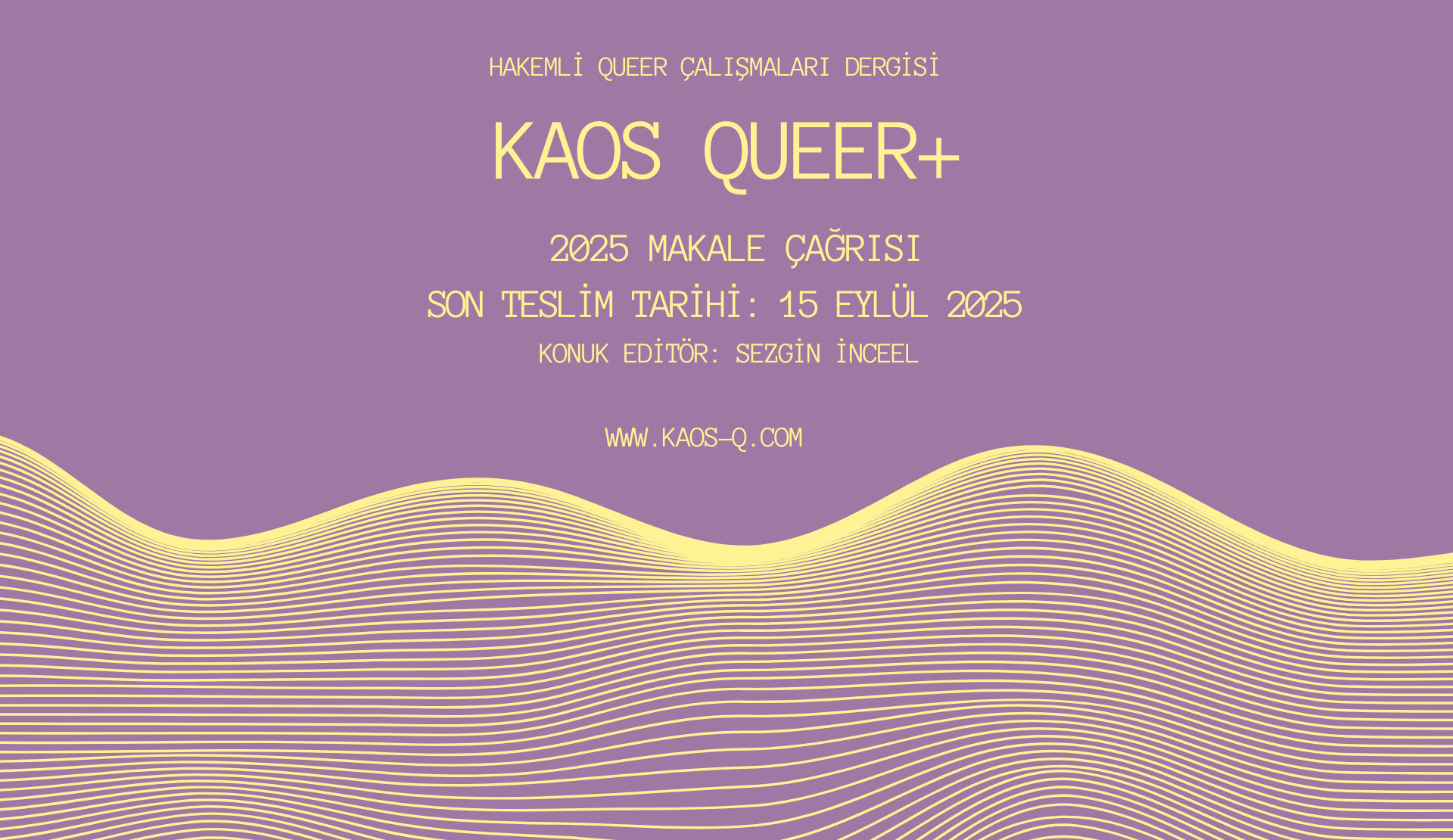
I am happy to be the guest editor of the new issue of the peer-reviewed queer studies journal Kaos Q+. Below are the details in English and Turkish.
“The peer-reviewed queer studies journal Kaos Q+, published in print since 2014, is now going digital!
The first issue in the new digital format will be published with the sub-theme “Voice”, guest-edited by Sezgin İnceel. You may submit your contributions to editor@kaosgl.org until 15 September 2025.
As Kaos Q+, throughout our 13 issues published so far, we have aimed not only to focus on theory, but also to engage with the conflicted, permeable, resistant, and norm-breaking potential of queerness. Through themes such as the body, desire, borders, labor, discipline-training, queer cinema, literature, queer history, transfeminism, queer political economy, grief, death and ghosts, and posthumanism, we have attempted to establish queerness not merely as an identity politics but as a way of thinking and intervening.
We have discussed how queer theories and practices create collective and plural spaces of experience, how they come into conflict with normative structures, and how they erode the boundaries of identity politics. Beginning with the 2025 issue, by shifting from print to digital publishing, we aim to open critical queer thought to a much wider network of access, discussion, and circulation.
Another piece of news is that as of 2025, Kaos Q+ will continue not only with themed issues, but will also welcome all original, independent, and interdisciplinary contributions in queer theory and LGBTI+ studies. Each issue will still feature a special focus section built around a sub-theme.
The first issue of our new digital format will be published with the sub-theme “Voice”, guest-edited by Sezgin İnceel. The detailed call for papers for this issue is as follows:
**“Whose voice is considered legitimate? Which bodies operate ‘in harmony’? Which cultural, financial, symbolic, and social capitals speak the loudest? Which bodily or social norms shape the voice? Silence can be a voice as much as sound; but what meanings does it produce?
Today, we know that voice is not only an individual expression, but also a field of social struggles, identities, the body, and collective desires. In a time when repression and censorship are steadily increasing, the question of whose voice is suppressed and whose is considered acceptable opens up an important field of discussion both politically and theoretically.
Judith Butler’s (1990, 1993) concept of performativity understands gender not as a fixed attribute but as an illusion of stable gender identity produced through repeated acts based on binary categories such as ‘man’ and ‘woman.’ Suzanne Cusick (1999) extends this theoretical framework to the auditory realm, arguing that the human voice is not only a medium of transmission but also a bodily site where gender is both performed and perceived. Rebecca Grotjahn (2010) raises the question of whether voices inherently possess a gender or whether gender is externally imposed upon them. Grotjahn states, ‘Almost no musical activity appears to be as strongly determined by gender as singing,’ pointing out that the clear boundaries between voice ranges—soprano, tenor, alto, bass—traditionally associated with men and women should be questioned, and she argues that there is considerable overlap between these categories. This points to fluid boundaries and potentials of voice rather than fixed categories.
In identity formations based on voice, axes such as class, race, gender, and the body often intersect and influence one another. The view that ‘the human voice emerges from the perfect harmony of the entire body working together’ (Ömür, 2004, p. 19) is open to critique in this context: Who defines this ‘perfection’? Through posthumanist approaches, can the human voice be reconsidered not only within the context of social hierarchies but also within intersubjective relationships involving nature, technology, and artificial intelligence?”**
Those who wish to contribute to this issue, which is open to academic, artistic, and literary work, should send texts between 3,000 and 6,000 words to editor@kaosgl.org by 15 September 2025. Submissions must include Turkish and English abstracts of 100–150 words, along with 5 keywords listed beneath each abstract.
For any questions regarding the issue, you can contact us at sezgin.inceel@ku.de and editor@kaosgl.org.
Suggested Topics
• Studies on gender through the singing/speaking voice
• The voice of queers in popular culture
• The voice of queer activism
• The relationship between language, voice, and queer theory
• Podcasts, queer narratives, and audio media
• Listening, hearing politics, and modes of communication
• Trans studies and voice
• Voice at the level of the body: ableism, ageism, and normative body politics
• Voice within posthumanist approaches
Note: This translation was prepared with the assistance of ChatGPT.
Kaos Q+’dan 2025 makale çağrısı: Dijitalleşen KaosQ+, “Ses” alt temasıyla yayımlanacak
Yeni dijital formatın ilk sayısı, Sezgin İnceel’in konuk editörlüğünde “Ses” alt temasıyla yayımlanacak. Katkılarınızı 15 Eylül 2025 tarihine kadar editor@kaosgl.org adresine gönderebilirsiniz.
2014’ten bu yana matbu olarak yayımlanan hakemli queer çalışmaları dergisi Kaos Q+, artık dijitalleşiyor!
Kaos Q+ olarak bugüne dek yalnızca teoriye değil, aynı zamanda queer’in çatışmalı, geçirgen, direnişçi ve norm kırıcı potansiyeline odaklanarak yol almaya, beden, arzu, sınır, emek, talim-terbiye, queer sinema, edebiyat, queer tarih, transfeminizm, queer politik ekonomi, yas, ölüm ve hayaletler, posthümanizm gibi temalar etrafında yayımlanan 13 sayımız boyunca, queeri yalnızca bir kimlik politikası değil, bir düşünme ve müdahale biçimi olarak kurmaya çalıştık.
Queer teori ve pratiklerin iç içe geçtiği kolektif ve çoğul deneyim alanlarını nasıl yarattığını, normatif yapılarla nasıl çatıştığını ve kimlik politikalarının sınırlarını nasıl aşındırdığını tartıştık. 2025 sayısı itibariyle, matbu formattan dijital yayıncılığa geçerek, eleştirel queer düşüncenin çok daha geniş bir erişim, tartışma ve dolaşım ağına açılmasını hedefliyoruz.
Bir diğer haberimiz ise 2025 itibariyle KaosQ+’nın yalnızca tema dosyalarına değil, queer teori ve LGBTİ+ çalışmalarının tüm özgün, bağımsız ve disiplinlerarası katkılarına açık bir yayın politikasıyla yoluna devam edeceği. Her sayı ise yine bir alt tema etrafında özel bir odak bölümüne yer verecek.
Yeni dijital formatımızın ilk sayısı, Sezgin İnceel’in konuk editörlüğünde ‘Ses’ alt temasıyla yayımlanacak. Bu sayının detaylı çağrı metni ise şöyle;
“Kimin sesi makbul kabul edilir? Hangi bedenler “uyum” içinde çalışır? Hangi kültürel, finansal, sembolik ve sosyal sermayelerin sesleri daha çok çıkar? Hangi bedensel ya da toplumsal normlar sesi şekillendirir? Sesin kendisi kadar sessizlik de bir ses olabilir; peki hangi anlamları üretir?
Bugün sesin yalnızca bireysel bir ifade değil, aynı zamanda toplumsal mücadelelerin, kimliklerin, bedenin ve kolektif arzuların alanı olduğunu biliyoruz. Baskının ve sansürün giderek arttığı bir dönemde, kimin sesinin bastırıldığı, hangi sesinin makbul sayıldığı sorusu hem politik hem kuramsal bağlamda önemli bir tartışma alanı açıyor.
Judith Butler’ın (1990, 1993) performativite kavramı, cinsiyeti sahip olunan sabit bir olgu olarak görmek yerine, tekrar eden eylemler aracılığıyla inşa edilen ve “erkek” ile “kadın” gibi ikili kategorilere dayanan istikrarlı bir cinsiyet kimliği yanılsaması olarak ele alır. Suzanne Cusick (1999), bu kuramsal çerçeveyi işitsel alana taşıyarak insan sesinin yalnızca bir iletim aracı değil, aynı zamanda cinsiyetin hem icra edildiği hem de algılandığı bedensel bir alan olduğunu öne sürer. Rebecca Grotjahn (2010) ise seslerin kendiliğinden bir cinsiyete sahip olup olmadığı ya da cinsiyetin onlara dışarıdan mı yüklendiği sorusunu gündeme getirir. Grotjahn, “Müzikle ilgili neredeyse hiçbir etkinlik, şarkı söylemek kadar güçlü bir şekilde cinsiyet tarafından belirlenmiş görünmemektedir,” diyerek, erkekler ve kadınlarla geleneksel olarak ilişkilendirilen soprano, tenor, alto, bas gibi ses aralıkları arasında net sınırların sorgulanması gerektiğini belirtir ve bu kategoriler arasında önemli ölçüde örtüşmeler bulunduğunu savunur. Bu da sabit kategoriler yerine, sesin akışkan sınırlarını ve potansiyelini işaret eder.
Ses üzerinden yapılan kimlik tanımlamalarında sınıf, ırk, toplumsal cinsiyet ve beden gibi eksenler çoğunlukla kesişimsel bir biçimde birbirini etkiler. “İnsan sesi tüm vücudun mükemmel bir uyum içinde çalışması sonucu gerçekleşir” (Ömür, 2004, s. 19) görüşü bu bağlamda sorgulanmaya açıktır: Bu “mükemmelliğin” tanımını kim yapar? Posthümanist yaklaşım(lar) sayesinde insan sesi yalnızca toplumsal hiyerarşiler bağlamında değil, aynı zamanda doğa, teknoloji ve yapay zekâ gibi öznelerarası ilişkiler bağlamında da yeniden düşünülebilir mi?”
Akademik, sanatsal ve edebi üretimlere açık bu sayıya katkıda bulunmak isteyenlerin, 3000–6000 kelime aralığındaki metinlerini 15 Eylül 2025 tarihine kadar editor@kaosgl.org adresine göndermeleri gerekmektedir. Gönderilecek metinlerde 100–150 kelimelik Türkçe ve İngilizce özetler ile birlikte, her iki özetin altında yer alacak 5 anahtar kelime bulunmalıdır.
Sayıyla ilgili her türlü soru için sezgin.inceel@ku.de ve editor@kaosgl.org adreslerinden bize ulaşabilirsiniz.
Konu önerileri
• Şarkı söyleme/konuşma sesi üzerinden toplumsal cinsiyet üzerine çalışmalar
• Popüler kültürde queerlerin sesi
• Queer aktivizmin sesi
• Dil, ses ve queer teori ilişkisi
• Podcast’ler, queer anlatılar ve sesli mecralar
• Dinleme, işitme politikaları ve iletişim biçimleri
• Trans çalışmaları ve ses
• Beden boyutunda ses: sağlamcılık, yaşçılık ve normatif beden politikaları
• Posthümanist yaklaşımlar çerçevesinde ses
 sezgin inceel