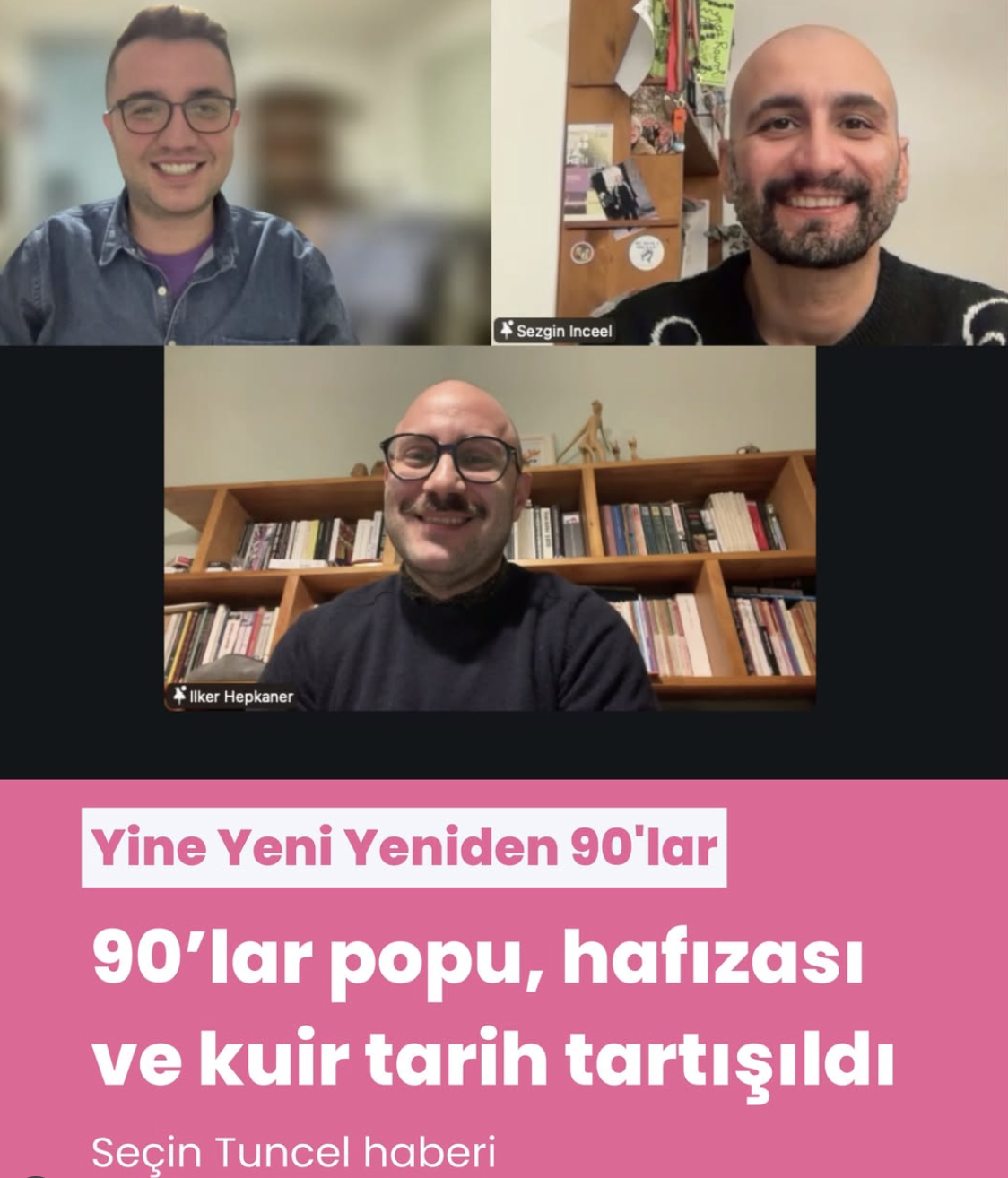
Thank you, Kaos GL, for having us in the Academic Talks series!
The ninth event of Kaos GL Queer Academy Network’s “Theoretical Conversations” series was held online on Thursday evening, October 9. Moderated by Yıldız Tar, the discussion featured İlker Hepkaner and Sezgin İnceel, co-authors of the book Again, Anew, the ’90s. Participants explored queer and feminist historiography, media representations, and our relationship with nostalgia through the lens of Turkish pop music from the 1990s.
At the opening, Yıldız Tar remarked, “We came across a work that recalls the ’90s — we listened to it and read about it for months,” noting that this period points not only to music but also to a multilayered era in terms of social memory. Emphasizing that the rise of pop music was accompanied by the emergence of a perception of “two different Turkeys,” Tar posed the question: “Did these two Turkeys ever truly connect?”
İlker Hepkaner underlined that the 1990s were a turning point both in music and in politics:
“With 2002, we entered a new phase, but we’re not happy with that phase. Clinging to the ’90s has become a strategy for happiness. Everyone remembers the ’90s fondly, but that decade was also marked by unsolved political murders, the Sivas Massacre, and the rise of neoliberal policies.”
Sezgin İnceel described the ’90s as a period “when representation was still limited”:
“Those were the years when TRT dominated the media and censorship was widespread. As private radio and TV channels multiplied, control decreased and production exploded. But this newfound freedom didn’t always translate into equality in representation.”
Recalling his own experiences, İnceel noted that queer representations in the media were often based on “characters made fun of”:
“There was no real queer persona, yet queers were constantly used as material for humor. Visibility in the media often came through ridicule.”
The full article is available on KaosGL1.org.
This English translation was created with the help of AI-based translation support, adapted from the original Kaos GL Instagram post: https://www.instagram.com/p/DPymRwVAr6Y/
Kaos GL Queer Akademi Ağı’nın “Kuramsal Sohbetler” serisinin dokuzuncusu, 9 Ekim Perşembe akşamı çevrimiçi olarak gerçekleşti. Yıldız Tar’ın moderasyonunda yapılan buluşmanın konukları, Yine Yeni Yeniden 90’lar kitabının yazarlarından İlker Hepkaner ve Sezgin İnceel’di. Katılımcılar, 90’ların Türkçe pop müziği üzerinden kuir ve feminist tarih yazımını, medya temsillerini ve nostaljiyle kurduğumuz ilişkiyi tartıştı.
Yıldız Tar, açılışta “90’ları hatırlayan bir işle karşılaştık, aylarca dinledik ve okuduk” diyerek, bu dönemin yalnızca müzik değil, aynı zamanda toplumsal hafıza açısından da çok katmanlı bir döneme işaret ettiğini hatırlattı. Pop müziğin yükselişine paralel olarak “iki ayrı Türkiye” algısının oluştuğunu belirten Tar, “Bu iki Türkiye hiç ilişkilendi mi?” sorusunu tartışmaya açtı.
İlker Hepkaner, 90’ların hem müzikte hem siyasette kırılma noktası olduğunu vurguladı:
“2002’yle birlikte başka bir evreye girdik, ama o evreden memnun değiliz. 90’lara sarılmak bir mutluluk stratejisine dönüştü. Herkes 90’ları iyi hatırlıyor ama o dönem faili meçhul cinayetlerin, Sivas Katliamı’nın, neoliberal politikaların başladığı yıllardı.”
Sezgin İnceel, 90’ları “temsilin hâlâ sınırlı kaldığı” bir dönem olarak tanımladı:
“O yıllar TRT’nin baskın olduğu, sansürün yoğun yaşandığı dönemdi. Özel radyo ve televizyonlar çoğaldıkça denetim azaldı, üretim patladı. Ama bu özgürlük, her zaman temsil eşitliği anlamına gelmedi.”
İnceel, medyada lubunya temsillerinin genellikle “dalga geçilen karakterler” üzerinden kurulduğunu hatırlatarak kendi deneyiminden bahsetti:
“Lubunya personası yoktu, ama lubunyalar sürekli mizah malzemesi olarak kullanılıyordu. Medyada görünürlük, çoğu zaman aşağılama üzerinden sağlanıyordu.”
Haberin tamamı KaosGL1.org’ta
https://kaosgl1.org/haber/90-lar-popu-hafizasi-ve-kuir-tarih-tartisildi
 sezgin inceel